
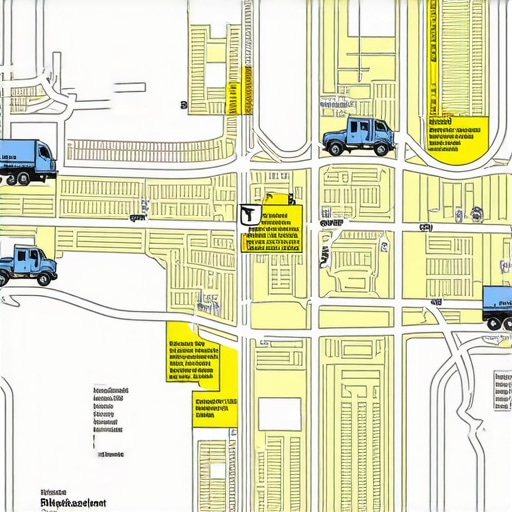
The Geo-Targeted Move: How Pest Control Teams Dominate Local Search
If you own a pest control company, you’ve likely experienced the “office bubble” frustration. You sit at your desk, search for “termite treatment near me,” and there you are – Number 1 in the Map Pack. You feel like a king. Then, you drive three miles down the road to a customer’s house, perform the same search, and suddenly your business is nowhere to be found. You’ve vanished from the map, replaced by competitors who might not even have a physical presence in that neighborhood.
This is the invisible problem plaguing the industry. Most owners think they have a ranking problem, but what they actually have is a proximity and relevance gap. In 2026, the landscape of google business profile seo has shifted. It is no longer enough to just “exist” in a city. To rank higher on google maps across your entire service territory, you must execute what I call the “Geo-Targeted Move.”
As the founder of Pest Control SEO and co-founder of Pest Control Millionaires, I’ve seen thousands of profiles. The ones that dominate aren’t necessarily the oldest or the ones with the most reviews; they are the ones that have mastered the art of projecting authority into specific neighborhoods. Proximity is no longer the sole king; in the age of AI-driven search, semantic relevance and hyperlocal prominence are the new power players. If you aren’t optimizing for the specific street corners where you work, you are effectively invisible to the customers who need you most.
The Service Area Business (SAB) Dilemma and the Proximity Myth
Pest control is a unique beast in the world of digital marketing. Unlike a coffee shop or a hair salon, customers rarely come to you. You go to them. This classifies you as a Service Area Business (SAB) in Google’s eyes. Historically, service area business seo has been treated like a second-class citizen compared to storefront businesses. There is a persistent “Proximity Myth” that suggests Google will only show your business to people within a tight radius of your verified address.
While proximity is a major ranking factor, it is often a crutch for poor optimization. Many pest control owners fall victim to the “Map Glitch” – a phenomenon where Google’s algorithm hides service area profiles in favor of distant competitors who have stronger “geo-signals.” Why does a company 15 miles away outrank you in your own backyard? It’s because Google trusts their relevance to that specific area more than yours.
Understanding Why Service Area Businesses Lose Leads to Distant Competitors is the first step in fixing your map presence. Google’s 2026 algorithm prioritizes businesses that prove they are active in a location. If your profile is tied to a home office in the suburbs but you want to kill ants in the high-value downtown district, you have to bridge that data gap manually. You cannot wait for Google to “figure it out.”
The “Geo-Targeted Move”: Building Hyperlocal Service Pages
The “Geo-Targeted Move” is a strategic shift away from generic city-wide targeting toward neighborhood-level dominance. In the past, you could get away with one “Service Areas” page that listed 50 zip codes. Today, that is a recipe for mediocrity. To truly rank higher on google maps, your website must act as a localized mirror of your physical operations.
Generic city pages are dead. If you are targeting Houston, you aren’t just competing for “Houston Pest Control.” You are competing for “Bed Bug Treatment in The Heights” or “Termite Inspection in Sugar Land.” High-intent leads come from users who search with specific intent. Research shows that seasonal keywords, such as “bed bugs” or “mosquito control,” see a massive spike in hyperlocal searches during peak months. If your site doesn’t have a dedicated page for that specific service in that specific neighborhood, you lose the “relevance” battle to a competitor who does.
When you learn How to Build Geo Pages That Actually Generate Leads Instead of Just Traffic, you stop focusing on vanity metrics and start focusing on phone calls. These pages should include localized testimonials, photos of your trucks in that neighborhood, and mentions of local landmarks. This creates a “Geo-Fence” of content that signals to Google: “We are the authority in this specific five-mile radius.” This is the foundational element of the The One Missing Element on Your Service Area Pages That Stops Local Calls – the lack of authentic, localized proof.
Google Business Profile Optimization for 2026
Your Google Business Profile (GBP) is your digital storefront. In 2026, google business profile optimization requires more than just filling out your phone number. It requires a deep dive into the technical “hidden” layers of the platform. The goal is to maximize your “surface area” so Google has more reasons to show your business for a variety of queries.
First, category selection is critical. While “Pest Control Service” is your obvious primary category, you are leaving money on the table if you ignore secondary categories like “Bird Control Service,” “Termite Control Service,” or “Wasps and Bees Control.” Google uses these categories to map your business to specific user needs. Furthermore, the “Services” section of your GBP should be treated like a secondary website. Each service needs a robust description (up to 300 words) that uses natural language to describe what you do and where you do it.
To ensure your profile is healthy, you should regularly use a google business profile audit tool. These tools can identify if your profile has “ghost” categories or if your NAP (Name, Address, Phone) data is being overwritten by third-party aggregators. Technical google business profile seo is about maintaining a clean, authoritative data set that Google can trust without hesitation. If there is even a slight discrepancy between your website and your GBP, Google will hedge its bets and rank a competitor instead. For those in highly competitive markets, utilizing a professional google maps optimization service can be the difference between being on page one or page ten.
The “Check-In” Strategy for Review Dominance
Reviews have always been a ranking factor, but the *type* of review matters more than ever. A generic “Great service!” review is worth very little in 2026. What moves the needle are reviews that contain “Geo-Context.” This is where the “Check-In” strategy comes into play.
When your technician finishes a job, they should send a text to the customer before they even pull out of the driveway. This isn’t just any text; it’s a localized request. By using The ‘Check-In’ Text That Actually Gets Us Google Reviews Fast, you encourage the customer to leave a review while their GPS coordinates match your business’s service activity. When a customer writes, “Dan helped us with a spider problem here in [Neighborhood Name],” and they post it from that exact location, it creates a massive trust signal for Google.
This “google review strategy” accomplishes two things: it proves you were actually at the location you claim to serve, and it provides semantic keywords (like “spider problem” and the neighborhood name) that help you rank for those specific terms. It turns every service call into a mini-SEO campaign. This is how you expand your “Map Pack” reach organically, pushing your green pins further and further away from your office.
Technical Signals, Schema, and the Unshakeable Foundation
Underneath the surface of your beautiful website lies the code that Google’s crawlers actually read. For pest control companies, LocalBusiness Schema is the most important piece of code you will ever implement. This structured data tells Google exactly who you are, what you do, and – most importantly – where you do it. It links your website, your social profiles, and your GBP into one cohesive entity.
Consistency is the bedrock of local SEO. Your NAP must be identical across the web. If your GBP says “Suite 101” and your website says “#101,” you are creating friction. Beyond basic NAP, you need to understand the 7 Local Ranking Signals That Drive Phone Calls, Not Just Impressions. One of these signals is the “Map Embed.” However, simply sticking a generic Google Map on your contact page is no longer enough. You need strategic embeds that highlight your service area boundaries.
Because the technical side of local SEO is becoming increasingly complex with AI-driven updates, many owners are turning to a google maps ranking service to handle the heavy lifting. These services use local seo tools to monitor your rankings on a grid, showing you exactly where you are winning and where you are losing. This data-driven approach allows you to stop guessing and start targeting the specific zip codes that have the highest search volume but the lowest competition.
Conclusion: Your Action Plan for Local Dominance
The “Geo-Targeted Move” isn’t a one-time task; it’s a philosophy of business growth. By moving away from general “pest control” keywords and focusing on hyperlocal relevance, you position your company as the obvious choice for both Google and your customers. Start by auditing your current profile, building out neighborhood-specific pages, and empowering your technicians to collect geo-located reviews.
The 2026 market is too competitive for “set it and forget it” SEO. If you want to dominate the map pack and secure your company’s future, you need a proactive strategy. Audit your profile today using professional tools, or partner with a specialized local seo agency to ensure your “Geo-Targeted Move” is executed with precision. Don’t let your competitors own the neighborhoods where you are already doing the work.